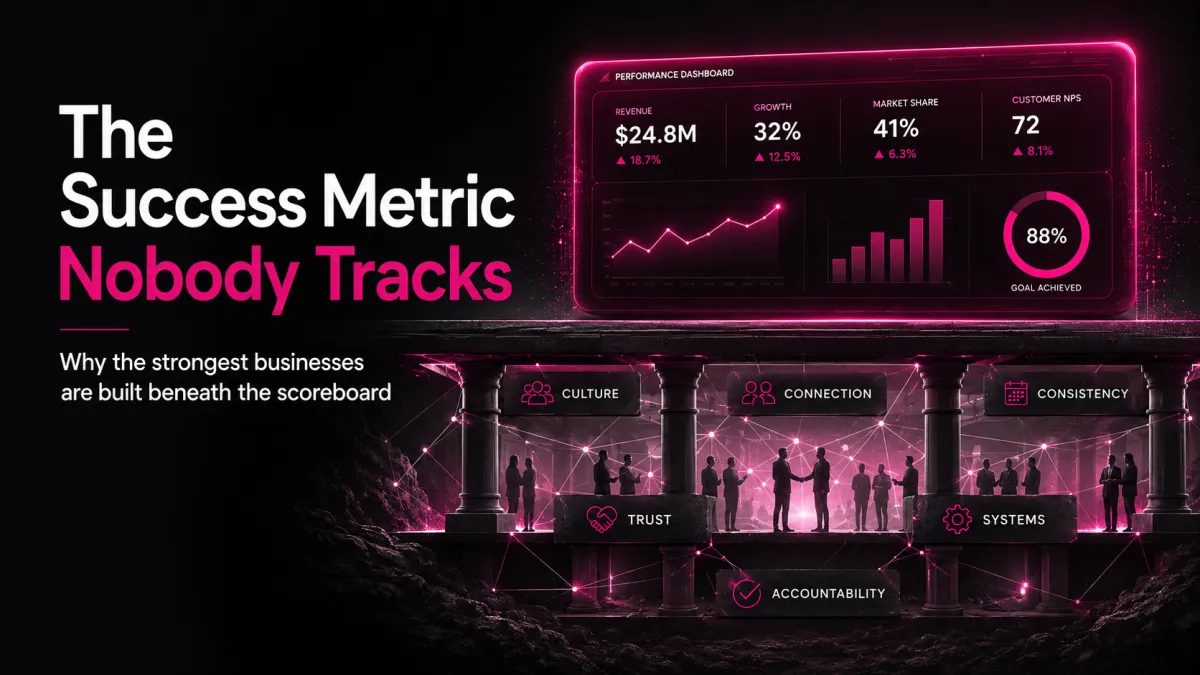
The Success Metric Nobody Tracks: Why Culture Drives Business Growth
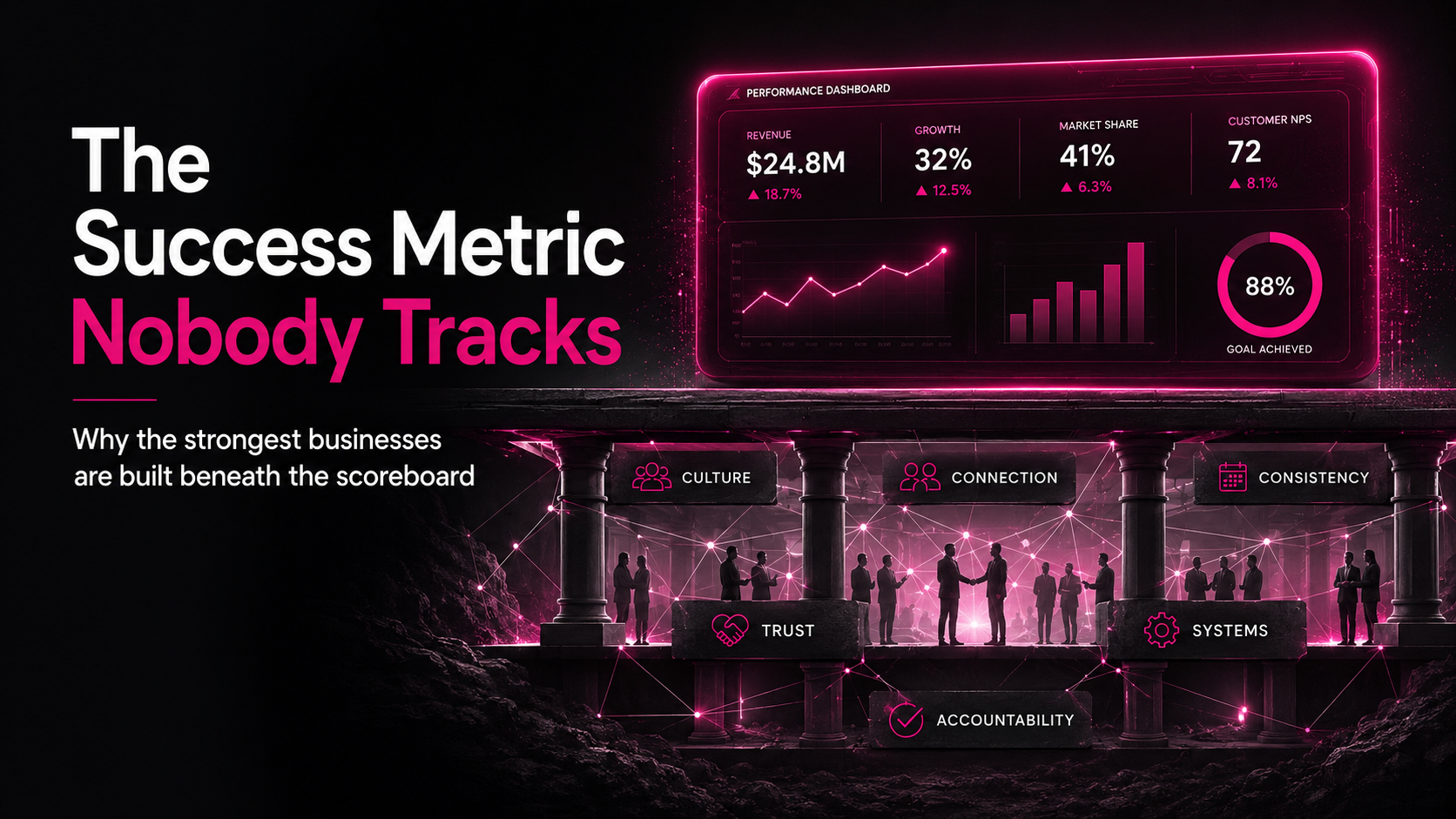
The Success Metric Nobody Tracks
Most leaders know their numbers.
They know the revenue.
They know the sales goals.
They know the close rate, the monthly target, the quarterly report, and the spreadsheet that gets updated before every leadership meeting.
And those numbers matter.
Profit keeps the lights on. Revenue keeps the doors open. Metrics give a business direction, accountability, and a way to know whether the work is moving.
But here is where a lot of leaders get it wrong:
They confuse the scoreboard with the strength of the business.
The scoreboard tells you what happened. It does not always tell you why it happened.
It does not show you the conversations that never happened. It does not show you the trust that started slipping. It does not show you the system people stopped believing in, the leader people stopped following, or the culture that quietly started pulling in the wrong direction.
And it does not always show the good stuff early enough either.
It may not show you when your team is getting stronger. When communication is becoming clearer. When people are buying into the mission. When outside partners, clients, or future employees start noticing something different and thinking, “I want to be part of that.”
That is the success metric nobody tracks.
Culture.
Connection.
Consistency.
The internal strength of the organization before it ever shows up on a financial report.
The Problem With Only Measuring the Outcome
Most traditional KPIs are lagging indicators. They tell you what has already happened.
Revenue dropped.
Sales increased.
Production slowed.
Retention improved.
Growth accelerated.
That information is useful. But by the time those numbers hit the report, the real story has often been unfolding for months.
If performance dips, the spreadsheet can show the dip. What it may not show is that communication got muddy, accountability became uneven, or the team stopped trusting the process.
If performance improves, the dashboard can celebrate the win. What it may not reveal is that your leaders became more aligned, your systems became more consistent, or your people finally started speaking the same language.
That is why leaders who only measure numbers can become blind to the very things creating those numbers.
You can hit a revenue target while your culture is cracking.
You can have a busy team and still have a misaligned team.
You can show growth on paper and exhaustion in the people.
And if you ignore that long enough, the business will eventually collect the invoice.
Culture Is Not Soft. It Is Structural.
Some leaders hear the word culture and think it belongs on a retreat agenda, a wall poster, or a hiring brochure.
That is not culture.
Culture is how people behave when the leader is not in the room.
It is how decisions get made.
It is how feedback is handled.
It is how conflict is navigated.
It is how people talk about the mission when the work gets heavy.
It is how expectations are carried, repeated, and reinforced.
Culture is not separate from operations. Culture is the operating environment.
When the environment is healthy, people can do strong work with clarity and consistency. When the environment is unhealthy, even talented people spend too much energy surviving the system instead of strengthening it.
That is why the best businesses do not just track what they produce.
They pay attention to what their environment is producing.
Are people growing?
Are systems being used?
Are expectations clear?
Are relationships strong enough to carry hard conversations?
Are people accountable without needing to be chased?
Those are not soft signals.
Those are business signals.
Attraction Is a Serious Metric
One of the clearest signs of a healthy organization is attraction.
When people interact with your team and walk away saying, “I want to be part of that,” pay attention.
That is not fluff. That is feedback.
It means your culture is visible from the outside. It means your systems, communication, leadership, and values are showing up in a way people can feel.
The strongest brands are not built only through marketing.
They are built through experience.
People believe what they experience with your team. They believe how your staff communicates. They believe how your systems feel. They believe how your organization handles pressure, change, conflict, follow-through, and service.
Your culture is already telling a story.
The only question is whether it is telling the story you think it is.
The Numbers Are the Outcome. Culture Is the Engine.
When culture, connection, and consistency improve, the business begins to move differently.
Teams communicate with more clarity. Leaders do not have to repeat the same message every week. Systems stop feeling like punishment and start creating rhythm. Accountability becomes less about chasing people and more about shared ownership.
Trust grows.
Execution sharpens.
Change becomes easier to absorb.
Eventually, the numbers reflect it.
But the numbers are the outcome. The culture is the engine.
This is where many leaders get impatient. They want the immediate spike. The instant return. The visible proof by Friday afternoon.
But real organizational strength rarely happens in a lightning strike.
It happens through repetition. Through consistent language. Through leaders modeling the standard. Through systems that reinforce what matters. Through people hearing the mission often enough that it becomes part of how they work.
The work that changes a business is not always dramatic.
Sometimes it is the steady rhythm that finally becomes the standard.
A Better Scorecard for Leaders
Keep the financial metrics. Keep the revenue goals. Keep the operational reports.
But do not stop there.
Start reviewing these five areas every month or quarter:
Culture:Are team norms getting stronger or weaker?
Connection:Are relationships and communication becoming more honest, clear, and productive?
Consistency:Are systems being followed reliably? Are expectations applied evenly?
Accountability:Are people owning their responsibilities without constant chasing?
Attraction:Are people outside the organization noticing what is working?
This scorecard will not replace your KPIs.
It will complete them.
Because the healthiest organizations are not choosing between people and performance. They understand that people, systems, culture, and performance are connected.
So here is the real leadership question:
What are you calling success right now?
Is it only the number at the end of the month? Or are you also measuring the conditions that make better numbers possible?
Because if your business is growing but your culture is weakening, you are not building strength. You are borrowing time.
But if your people are aligned, your communication is clear, your systems are consistent, your accountability is shared, and others can feel the strength of what you are building, then you are tracking something much deeper than a KPI.
You are tracking sustainability.
You are tracking momentum.
You are tracking the kind of success that compounds over time.
And that may be the metric that changes everything.